
How to Study With Index Cards: Writing, Spacing and the Leitner Box
Write each card as one question, quiz yourself instead of rereading, and let a three-box Leitner system decide which cards come back tomorrow and which can wait a week.
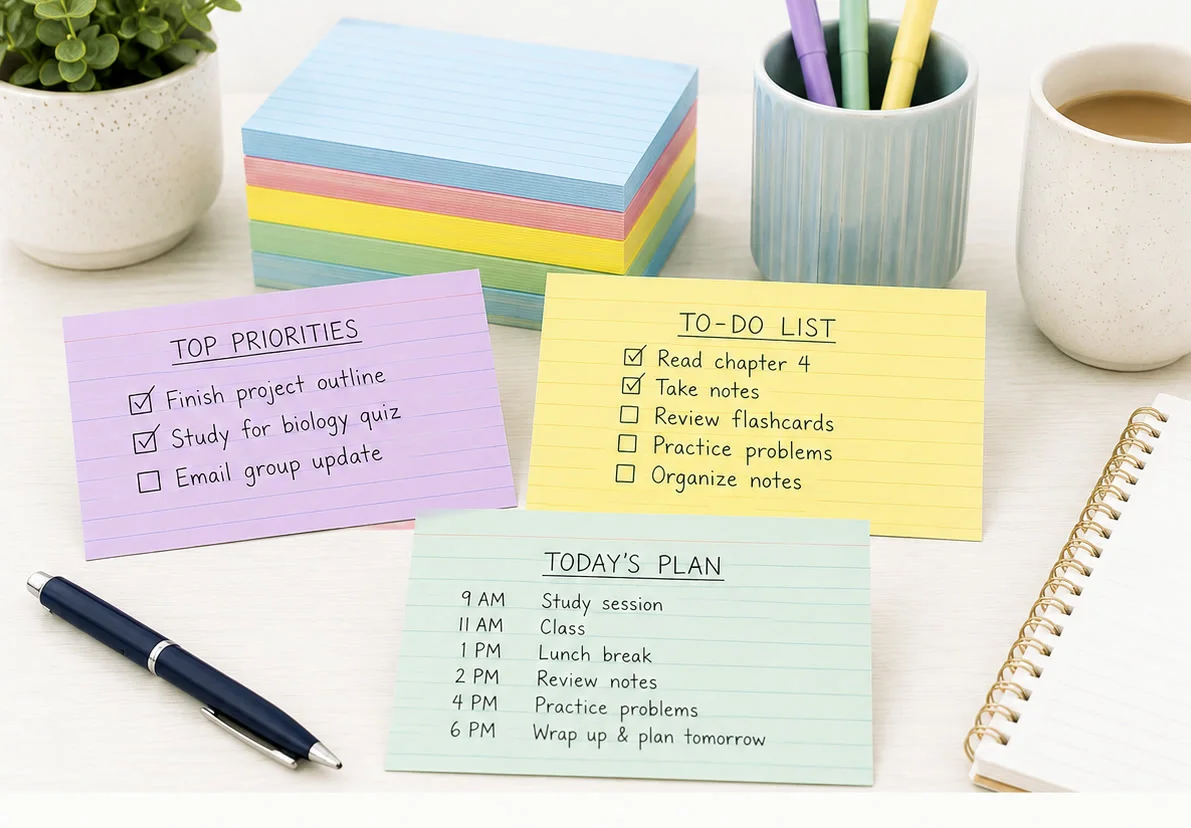
Why a card beats another pass through your notes
Most students study by reading their notes again, often with a highlighter in hand. In 2013, five psychologists led by John Dunlosky reviewed 10 learning techniques for Psychological Science in the Public Interest and asked whether each one helped across different learners, materials and kinds of tests. Two came out on top with high utility assessments: practice testing and distributed practice. The bottom of the list holds the habits most of us grew up with.
Five techniques received a low utility assessment: summarization, highlighting, the keyword mnemonic, imagery use for text learning, and rereading.
John Dunlosky, Katherine A. Rawson, Elizabeth J. Marsh, Mitchell J. Nathan and Daniel T. Willingham, Improving Students' Learning With Effective Learning Techniques (2013)
An index card is a practice test you can hold in one hand. The question sits on the front, the answer waits on the back, and the only honest way to reach the answer is to try first. Rereading a page of pharmacology notes feels productive because every line looks familiar. A card gives you the truth at once: either the drug class came to mind or it did not.
Cards also make the second winner, distributed practice, easy to run. A deck splits into piles, the piles go into a box, and the box tells you which questions to face today. None of that works with a highlighted textbook, where every page waits for you with the same urgency.
The rest of the method is craft. A badly written card, crowded with a paragraph copied from the lecture slides, turns testing back into rereading. So the work starts with the pen.
Write one question per card, and size the card to the answer
Put one question on the front and only its answer on the back. A card that asks you to name the four chambers of the heart and the valve after each one is really three cards pretending to be one. Get half of it right and you cannot tell which half needs another look. Split it.
Questions in your own words work better than lines lifted from the book, because writing them is already the first round of practice. Language learners can put the word on the front and the meaning, the gender and one example sentence on the back. A nursing student might write a drug name on the front and its class, main use and one warning on the back. For math and chemistry, the problem goes on the front and the worked steps go on the back.
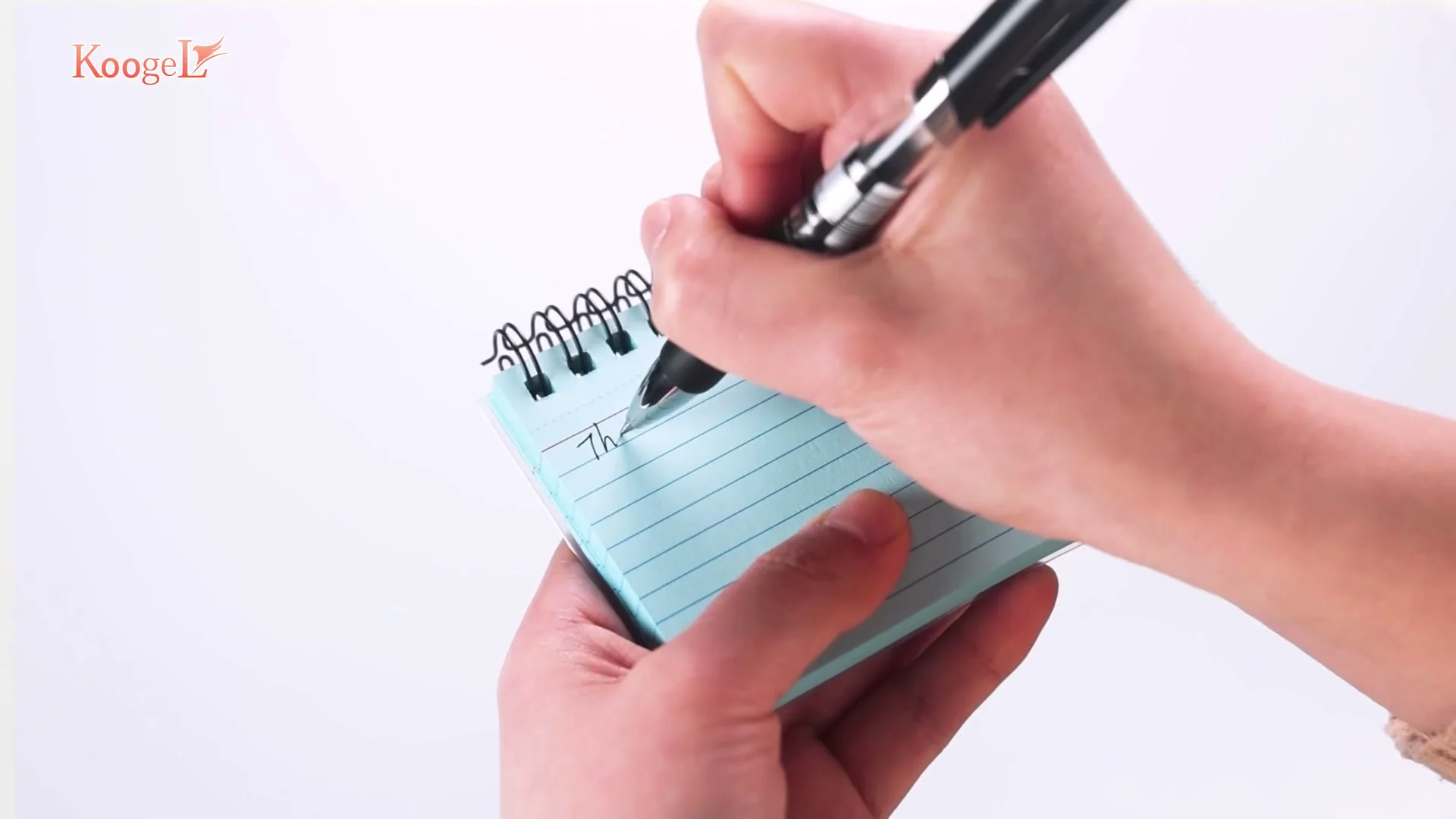
Size follows the answer. A one-word definition fits a 2.2 x 3.5 card, the size of a business card. Vocabulary with an example sentence needs the classic 3 x 5, and a formula with its steps, a labeled diagram or a timeline wants 4 x 6. Paper weight matters as well. At 230gsm our ring cards are nearly as stiff as playing cards, while 150gsm cards stack thinner in a box. Our cardstock weight guide explains what those gsm numbers feel like in the hand.
| Card size | What fits on one card | Koogel cards in this size |
|---|---|---|
| 2.2 x 3.5 in | One term, one date, one short answer | Ring Flash Cards, 300 Count (230gsm, 6 colors) · Ring Flash Cards, 1080 Count · Ring Flash Cards, 1500 Count, 7 Colors · Key-Ring Flash Cards (250, 400 or 600 cards) · Lined Ring Flash Cards, 300 Count |
| 3 x 5 in | A word with an example sentence, a drug card, a short list | Spiral Index Cards 3 x 5, Lined, 400 Count (180gsm) · Ring Index Cards 3 x 5, 480 Count (230gsm) · Colored Ruled Index Cards 3 x 5 (272 count, or packs of 200 to 1200) · Index Cards 3 x 5 with Tab Dividers, 252 Count · Spiral Index Cards 3 x 5, 500 Count · Colored Blank Index Cards 3 x 5, 272 Count · Lined Ring Flash Cards in the 3 x 5 option |
| 4 x 6 in | A formula with steps, a diagram, a timeline, an outline | Spiral Index Cards 4 x 6, 400 Count (8 pads of 50) · Large Neon Index Cards, 4 x 6, blank or lined |
| 5 x 8 in | A chapter map, speech notes, a whole process on one face | Large Neon Index Cards, 5 x 8, blank or lined |
Each of these sets sits on our index card shelf with its count and colors listed on the card.
Quiz yourself, then let time do half the work
Saying the answer before you flip is the whole trick. Flip first and nod along, and you have only reread the card. Say it out loud or write it on scrap paper, then turn the card over and grade yourself: right, close or wrong. Put a small pencil tick in the corner of a card each time you miss it. Three ticks mean the card needs rewriting, not another round.
Timing is the other half. In 2009 the psychologist Nate Kornell ran three experiments in which participants learned GRE-type word pairs with a web-based flashcard program. Studying one large stack beat studying four smaller stacks separately, because in the large stack each card came back only after many others. Spacing also beat cramming, which he described as massing study on the last day before the test. What the learners believed was another story.
Across experiments, spacing was more effective than massing for 90% of the participants, yet after the first study session, 72% of the participants believed that massing had been more effective than spacing.
Nate Kornell, Optimising learning using flashcards: Spacing is more effective than cramming, Applied Cognitive Psychology (2009)
Small stacks feel better because the answer you saw a minute ago is still warm. That ease fooled 72% of Kornell's participants. Run the whole deck in one pass so each card waits its turn, and expect to miss more on the first loop. Those misses are where the learning happens.
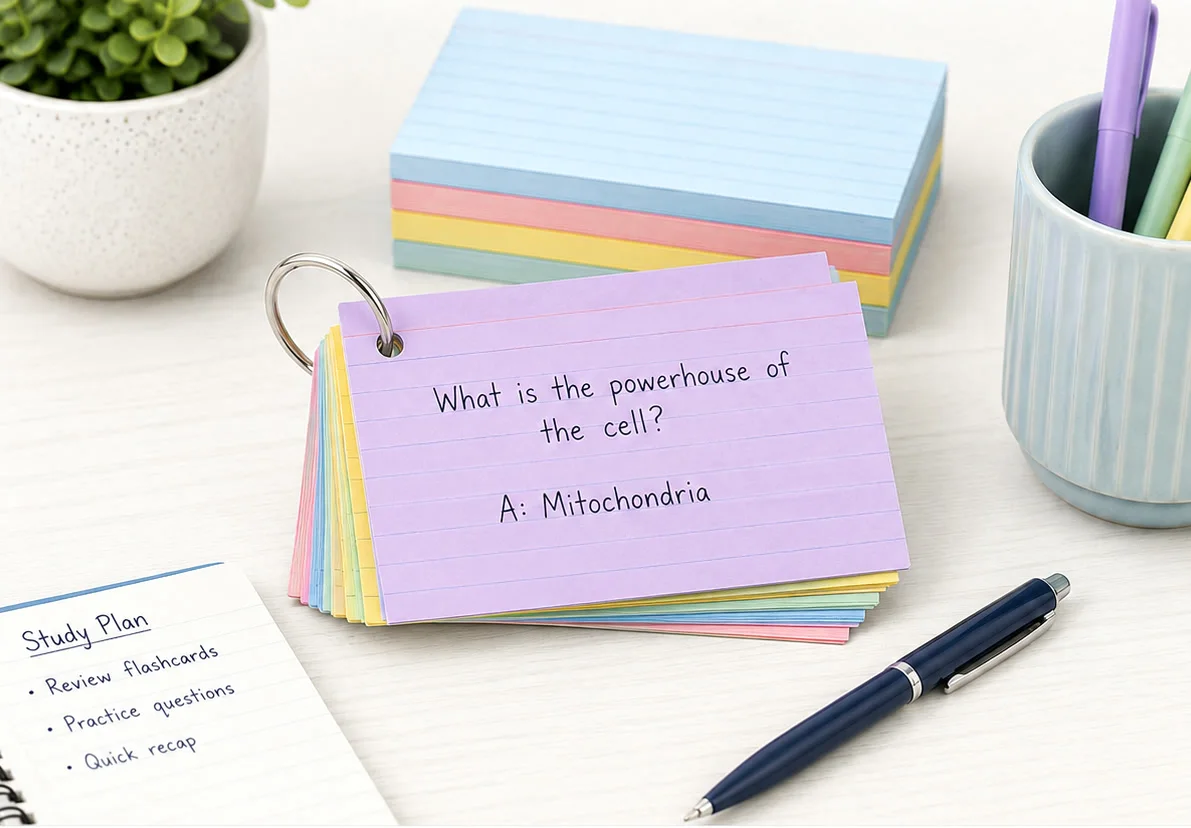
Spacing also means coming back on other days. The same logic favors twenty minutes on four separate evenings over eighty minutes on the night before the exam. Keeping track of which card is due on which evening sounds like bookkeeping, and it is. A box with three compartments does that bookkeeping for you.
Run a Leitner box, week by week
The Leitner system sorts cards by how well you know them, so the hard ones come back often and the easy ones rest. At Kansas State University, the Academic Achievement Center lays it out with three stacks. All new cards start in Stack 1, which you review every day. A card you answer correctly moves up to Stack 2, reviewed every other day. Miss a card and it drops back one stack. Cards that come through Stack 2 move on to Stack 3, which you review less often than the first two. Once the whole deck reaches Stack 3, the center suggests a weekly review for continuous learning.
Any shoebox with two dividers will do, and so will three rubber bands. What matters is that you move cards honestly. A card you answered slowly, or only half right, counts as a miss.
Here is how that looks across the four weeks before a midterm, with new cards added as the lectures arrive:
| Week | Box 1: new and missed cards | Box 2: right once | Box 3: right twice | What changes this week |
|---|---|---|---|---|
| Week 1 | Every day | Every other day, from day 2 | Empty | Write the first unit's cards, all of them start in Box 1 |
| Week 2 | Every day | Every other day | Once, at the end of the week | New cards from this week's lectures go into Box 1 |
| Week 3 | Every day, usually a short pile by now | Every other day | Once a week | A Box 3 card you miss drops back to Box 2 |
| Week 4, exam week | Every day | Every day | Two passes, early and midweek | No new cards. Run the whole deck in one pass two days out |
| After the exam | Retire or rewrite | Merge into Box 3 | Once a week | Keep the deck alive for the final |
Expect Box 1 to stay small if your cards are well written. When it keeps growing, the cards are usually too crowded, and splitting them fixes more than reviewing them harder does. A card that bounces between Box 1 and Box 2 for a whole week is telling you something about the card. Rewrite it smaller, add a cue to the front, or cut it in two. With vocabulary, the bouncing card is often one of two look-alike words, and a single card that asks for the difference between them settles both.
Color by subject or by difficulty
Color does one job well: it lets you find a pile without reading a single card. Pick one meaning for color per deck, though. Colors that mean the course on Monday and the difficulty on Thursday turn the box back into a heap.
Coloring by subject suits students carrying four or five courses. Give biology one color, chemistry another and statistics a third, and one Leitner box can hold all of them, with each color sorted inside its own compartment. Our Colored Ruled Index Cards 3 x 5 come in 8 colors with college ruled lines on both sides. Pick the 272-count pack, with 34 of each color, or a bulk pack of 200 to 1200. The 300-count ring set comes in 6 colors with 50 cards per color, so each course can claim its own color from the first day.
Coloring by difficulty works better for one big subject, such as a language or the pharmacology unit of a nursing program. Write every card on the same color and mark the hard ones as they prove hard. Our Color Coding Dot Stickers carry 3360 dots, 3/4 inch across in 12 colors, and they take pen, pencil and marker. One red dot on a card you missed twice tells you, without any sorting, that it belongs at the front of tomorrow's pile.
Parents helping younger kids can use color by type: sight words on one color, math facts on another, spelling words on a third. A child reaches for the right stack by color long before reading the labels. The dot stickers, binder rings and other small tools for this sit on our desk and school supplies shelf.
Ring, spiral or loose: when each one wins
A ring keeps a deck in order and lets you flip with one hand. All five of our flash card sets come on rings for that reason. Cards slide on and off, so a card you have mastered can leave the ring and a new one can join it. The catch is shuffling. To mix the order, or to move a card from Box 1 to Box 2, the ring has to open. The fix is one ring per Leitner box. Our Metal Binder Rings are steel, 1.2 inches across on the outside and 1 inch inside, in 10 colors, and they open with a pull and close with a squeeze.
Spiral cards win on the day you write them. A spiral pad behaves like a small notebook, so you can take notes in a lecture without loose cards sliding off the desk. Our 3 x 5 spiral sets have perforated edges, so a finished card tears out cleanly. On the 500-count set and the 4 x 6 set, PVC covers keep a coffee spill off your notes. The limit is that bound cards cannot be shuffled or sorted. Write in the spiral during the week, then tear the cards out on the weekend and file them into your box.
Loose cards are the easiest to sort, and the Leitner system was built around them. Our Index Cards 3 x 5 with Tab Dividers come 252 to a pack in 6 colors. Each card has a header strip you can label, so a few of them can serve as the dividers between your boxes or chapters. Their weakness is the backpack. A loose deck scatters the first time a bag tips over, so carry it on a ring or under a band.
Keep the deck where your free minutes are
Spacing only works if the cards are with you when the free minutes come: the bus, the lunch line, the ten minutes before a clinical shift, the wait at a pediatrician's office. A 2.2 x 3.5 card covers 7.7 square inches against 15 for a 3 x 5. That is about half the face, so a stack of them rides in a jacket pocket where a 3 x 5 deck would bend.
Carry only what is due. Box 1 and Box 2 come with you, because those are the cards you review every day or every other day. Leave Box 3 at home for its weekly pass at your desk. A ring of thirty hard cards gets flipped far more often than a full deck that never leaves the bag.
Our Key-Ring Flash Cards are built for exactly that pocket. The 250-card pack holds 2.2 x 3.5 cards in 5 colors, 50 of each. It also comes with 10 waterproof covers and 5 binder rings, and packs of 400 and 600 cards sit on the same card on our shelf. A ring of French verbs clips to a backpack strap, and a ring of anatomy terms rides on a lanyard through a hospital shift.
Language learners and nursing students carry the same habit for different reasons. Both face a large pile of small facts, and both get better results from many short sessions than from a few long ones. Koogel has been making paper goods since 2009, and you can see the whole set of cards, rings and pads in the Koogel range. Pick the size that fits your answers, write one question per card, and start Box 1 tonight.